
Executive Summary
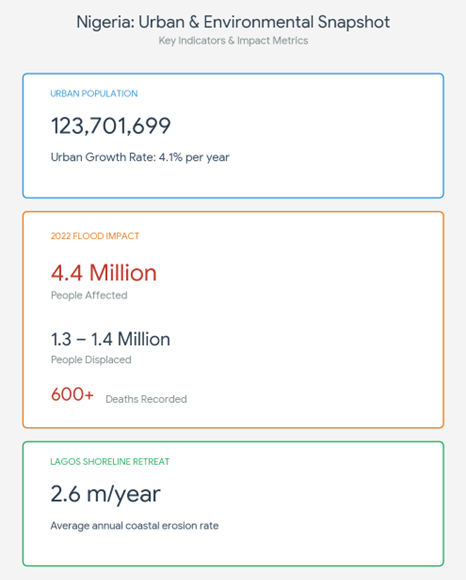
Nigeria’s failure to realise Sustainable Development Goal (SDG) 11, sustainable, resilient, and inclusive cities, is fundamentally a governance and delivery challenge rather than a deficit of policy intent or technical knowledge. Rapid urbanisation, with an urban population of over 123 million growing at 4.1 per cent annually, has intersected with intensifying climate risks to expose infrastructure systems built without enforceable standards, coordinated mandates, or predictable financing. The 2022 floods alone affected 4.4 million people, displaced up to 1.4 million, and caused widespread damage to roads, housing, and economic assets, while coastal cities such as Lagos face accelerating shoreline erosion averaging about 2.6 meters per year.
This policy brief argues that binding governance reform is the decisive lever for achieving SDG 11. The core constraint is weak enforcement of resilience standards and fragmented decision authority across federal, state, and local institutions, allowing political and informal considerations to override risk-informed planning.
Drawing on comparative lessons from Bangladesh, the Netherlands, the Philippines, and South Africa, this brief proposes a coherent reform package centered on statutory accountability, climate-proofed infrastructure standards, conditional and decentralised finance, coastal and nature-based defenses, and integrated data and early warning systems.
If implemented, these reforms would reduce lifecycle infrastructure losses, protect vulnerable urban populations, and directly advance SDG 11 targets, particularly disaster loss reduction (11.5) and integrated resilience planning (11.b), by aligning incentives, finance, and delivery with climate-resilient urban development.
From Governance Reform to Resilient Cities
Nigeria’s urban infrastructure vulnerability does not stem from a lack of policy intent, but from the failure to translate statutory commitments into risk-informed decisions at scale. The pathway from governance reform to sustainable, resilient cities can be summarised as follows:
Statutory reform and delivery discipline: CRIAA clarifies mandates, embeds climate-risk standards in procurement and planning, and links compliance to finance and oversight.
Improved infrastructure decisions: Climate-proofed roads, drainage, housing, and coastal investments reduce exposure to floods, heat, and erosion. World Bank evidence from Africa shows upfront resilience reduces asset losses by 20–40% over project lifetimes.
Reduced exposure and losses: Particularly for low-income urban residents and critical economic corridors, fewer disaster-related displacements, lower household losses, and improved service continuity result.
Accelerated SDG 11 progress: Specifically, SDG 11.5 (reducing disaster losses) and SDG 11.b (integrated resilience planning) become achievable when governance reform shifts incentives rather than rhetoric
Key insight: Governance reform achieves the greatest impact when it directly constrains how infrastructure decisions are made and financed, rather than creating new institutions.
Urban Infrastructure Challenges in Nigeria
Urban infrastructure deficits in Nigeria are the product of decades of rapid urbanisation, weak planning, and chronic underinvestment. By 2023, the urban population reached 123.7 million, growing at 4.1% annually, intensifying pressure on housing, drainage, transport, and basic services.
Historically, recurrent floods, coastal erosion, and unplanned settlement expansion have amplified these structural weaknesses. The 2022 floods were among the worst in a decade, affecting 4.4 million people (including 2.6 million children), displacing 1.3–1.4 million, and causing over 600 deaths. Roads, bridges, homes, and agricultural assets suffered extensive damage, with national and humanitarian assessments documenting significant household losses and infrastructure disruption.
Coastal and metropolitan corridors demonstrate acute climate exposure. Remote-sensing and field studies show shoreline retreat along the Lagos lagoon and peninsula averaging 2.6 metres per year in some areas, threatening housing, ports, and arterial roads, and increasing the cost and complexity of infrastructure protection.
Where resilience policies exist, such as the National Climate Change Policy and state- and city-level plans, implementation gaps remain. Fragmented mandates and weak coordination among federal ministries (Works & Housing, Environment, Housing & Urban Development), response bodies (NEMA), planning and statistical agencies (National Bureau of Statistics; state and metropolitan authorities), and local governments have hindered the mainstreaming of risk-informed standards into infrastructure design, procurement, and budgeting.
Multi-dimensional impacts:
● Social/Cultural: repeated displacement deepens informal settlement growth and community disruption.
● Political: visible infrastructure failures erode citizen trust and redirect resources to emergency response.
● Economic: transport and market interruptions produce quantifiable direct and opportunity losses for households and firms.
● Psychological: recurrent shocks increase vulnerability and reduce livelihood security.
● Academic/Technical: fragmented evidence limits evaluation of scalable, financeable resilience solutions.
This policy brief addresses a clear gap between policy commitments and the operational implementation of climate-resilient infrastructure in Nigeria by:
● Synthesising empirical damage and loss data;
● Mapping institutional responsibilities and identifying key implementation bottlenecks;
● Quantifying financing shortfalls for climate-proofed infrastructure; and
● Recommending actionable governance and financing reforms aligned with SDG 11.
Enforcement Gaps and Decision Fragmentation
Nigeria’s urban resilience failure is not caused by a single deficit. Evidence points to weak enforcement of standards and fragmented decision-making authority as the primary binding constraints:
● Inconsistent standards: Federal, state, and municipal projects often diverge in implementation, undermining technical guidance.
● Finance gaps: Even when funding exists, climate-vulnerable infrastructure frequently proceeds without basic risk screening.
● Political capture and informal decision-making: Technical planning, especially in land use and drainage, is routinely overridden.
Implication: Strengthening enforcement and coordination offers higher returns than proliferating plans or standalone projects.
Lessons from International Experience
Several countries provide lessons for Nigeria’s climate-resilient infrastructure agenda:
Cross-cutting Lessons for Nigeria
-
Institutionalise resilience with law and delivery agencies: A statutory framework or permanent commission could align federal, state, and metropolitan investments.
-
Integrate long-term planning with local capacity: Coastal and urban plans must link explicitly to municipal implementation and early warning systems.
-
Condition reconstruction and finance on resilience standards: Transparent audit and accountability mechanisms reduce vulnerability growth.
-
Implement service-level resilience measures and demand management: Data-driven, socially equitable measures for water, waste, and energy networks strengthen preparedness.
-
Mobilise diversified finance and international support: Donor funds, national budgets, and private investment should be blended, including nature-based solutions and strategic retreat where necessary.
Policy Options: A Coherent Package for Climate-Resilient Urban Infrastructure
Nigeria’s infrastructure resilience deficit is not remedied by incremental fixes. It requires a coherent, mutually reinforcing package of reforms that align law, standards, finance, data, and local capacity. The following six policy themes constitute an integrated programme — Strengthening Nigeria’s Climate-Resilient Infrastructure Agenda — grounded in international practice and Nigeria-specific evidence (UNDP flood assessments; World Bank analysis).
Statutory Foundations for Resilience Delivery: The National Resilience Delivery and Accountability Act (NRDA)
Core proposition
Nigeria requires a binding legal framework that transforms resilience from aspiration into obligation. The proposed NRDA would set national resilience targets, clarify intergovernmental mandates, and create a Resilience Commission with a dedicated Secretariat and ring-fenced programme budget, operationalising the governance intent of the National Climate Change Policy.
Programme design
● Enact the NRDA and establish a Resilience Commission (chaired from the Office of the President).
● Create an inter-ministerial Delivery Board (Works & Housing; Environment; Housing and Urban Development; NEMA; NBS).
● Issue binding resilience design standards for all major infrastructure procurement.
Sequencing.
● 0–2 years: Draft the NRDA, conduct structured stakeholder consultations, and table the Bill.
● 3–5 years: Pass the Act, establish the Commission and Secretariat, and pilot city accreditation in 3–5 urban centres.
● 6–10 years: Integrate statutory data-sharing, ring-fenced budgets, and conditional transfers into routine federal–state fiscal and delivery systems.
Governance
Lead actors: Federal Ministry of Environment; Federal Ministry of Works and Housing; Ministry of Housing and Urban Development; NEMA; state governments; National Assembly.
Risks and mitigation.
Political resistance and legal overlap are likely. These should be managed through phased adoption, sunset clauses to harmonise existing statutes, and donor-supported capacity building.
2. Embedding Resilience in Standards and Spatial Planning
Core proposition
Resilience must be engineered into Nigeria’s built environment, not retrofitted after failure.
Programme design
● Produce a Resilience Design Manual for roads, drainage, bridges, coastal works, and water systems.
● Mandate climate-risk appraisal for all major capital projects.
● Implement a targeted retrofit programme for critical roads and drainage in the 12 most vulnerable cities.
Sequencing
● 0–2 years: Develop the Manual and pilot climate-risk appraisals on selected federal projects.
● 3–5 years: Make standards mandatory for federally funded projects; commence retrofits in priority cities.
● 6–10 years: Institutionalise lifecycle costing, professional accreditation in climate-smart design, and broad state adoption.
Risks and mitigation
Higher upfront costs and uneven enforcement should be countered through lifecycle costing, conditional transfers, and targeted grants for fiscally weaker states.
3. Coastal and Nature-Based Protection: The Integrated Urban Coastal Resilience Programme (IUCRP)
Core proposition
Nigeria’s coastline demands a hybrid approach that blends engineering with ecology and community adaptation.
Programme design
● Prioritised coastal risk mapping.
● Phased shoreline protection combining hard and soft measures.
● Community shelters and planned relocation corridors where protection is uneconomic.
Sequencing
● 0–2 years: Complete risk mapping and implement 2–3 hybrid pilots (notably in Lagos).
● 3–5 years: Scale shoreline protection and social safeguards.
● 6–10 years: Establish a financed maintenance regime with measurable reductions in coastal damage.
Risks and mitigation
Displacement risks and illegal sand mining must be addressed through compensation frameworks, enforcement, and expedited permitting with oversight.
4. Decentralised Capacity and Conditional Finance: Urban Resilience Grant Facility (URGF)
Core proposition
Resilience is built city by city. Municipalities require both capacity and incentives.
Programme design
● Municipal resilience labs and accredited project pipelines.
● Performance-based grants for drainage, slum upgrading, and early warning systems.
● Public transparency portal and third-party audits.
Sequencing
● 0–2 years: Design the URGF and pilot grants in 3–6 cities.
● 3–5 years: Expand to 12+ cities with performance-linked tranches.
● 6–10 years: Institutionalise accredited pipelines and mixed finance for municipal projects.
Risks and mitigation
Uneven capacity and corruption risks demand strict accreditation, independent audits, and public disclosure.
5. Mobilising Capital: A Resilience Investment Package
Core proposition
Without predictable finance, resilience remains rhetoric.
Programme design
● Establish a National Resilience Fund (public seed + concessional capital).
● Develop municipal and green bond markets for resilient infrastructure.
● Use guarantees to crowd in private investment for drainage, transport, and coastal works.
Sequencing
● 0–2 years: Finalise Fund design and conduct municipal bond feasibility studies.
● 3–5 years: Operationalise the Fund and issue pilot bonds with guarantees.
● 6–10 years: Scale a domestic resilience bond market.
Risks and mitigation
Fiscal constraints and investor caution should be managed through blended finance, credit enhancement, and currency risk management.
6. Data and Early Warning: National Urban Risk Information System (NURIS)
Core proposition
Good governance depends on good data.
Programme design
● Integrate hydro-meteorological monitoring, geospatial exposure maps, asset registries, and loss databases.
● Link data to municipal early warning systems and public dashboards.
Sequencing
● 0–2 years: Agree on data standards, deploy priority sensors, and launch pilot dashboards.
● 3–5 years: Standardise national loss reporting and integrate NURIS with NRDA and URGF processes.
● 6–10 years: Operate a fully integrated, automated national risk system.
Risks and mitigation
Fragmented data ownership should be resolved through statutory data-sharing mandates under the NRDA and phased deployment.
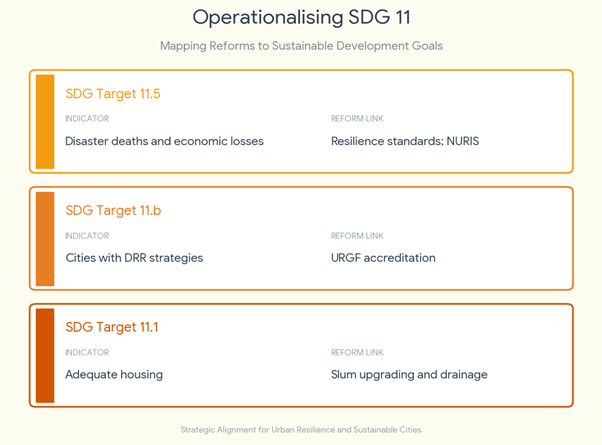
Operationalising SDG 11
To move beyond aspirational alignment, reforms must map directly to SDG 11 indicators:
Recommendations
1. Enact the National Resilience Delivery and Accountability Act (NRDA) to establish a Resilience Commission, a statutory delivery secretariat, and an inter-ministerial Delivery Board to align mandates across the Federal Ministry of Environment, Federal Ministry of Works and Housing, Ministry of Housing and Urban Development, NEMA, and state governments.
2. Mandate climate-proofed engineering and spatial standards via a national Resilience Design Manual and require climate-risk appraisals in all major capital projects to mainstream resilience into roads, drainage, bridges, and urban masterplans (federal and state public works, Standards Organisation of Nigeria, professional bodies).
3. Launch the IUCRP, combining hybrid shoreline protection, ecosystem restoration, and socially safeguarded relocation where necessary; prioritised risk mapping, and socially-safeguarded planned relocation corridors in Lagos, Bayelsa, Delta, and other coastal states (state governments, Federal Ministry of Environment, World Bank/ADB partners).
4. Establish an Urban Resilience Grant Facility (URGF) to provide accredited, performance-based conditional grants plus municipal capacity-building for local drainage, slum upgrading, and EWS investments (Federal Ministry of Housing and Urban Development, state ministries, local governments, development partners).
5. Create a Resilience Investment Mobilisation Package — a National Resilience Fund seeded by public and concessional donor capital, supported by guarantees and pilot municipal/green bond facilities to crowd-in private finance for bankable resilient infrastructure projects (Ministry of Finance, Debt Management Office, MDBs/DFIs, private sector).
6. Deploy a National Urban Risk Information System (NURIS) linking upgraded hydro meteorological networks, geospatial exposure maps, an asset registry, and standardised damage/loss reporting to power municipal EWS, planning, and public dashboards (NIMET, NBS, NEMA, universities/research institutes).
Conclusion
Nigeria’s crisis is not one of ideas, but of enforcement. Rapid urbanisation and intensifying climate shocks have exposed infrastructure built without binding standards or predictable finance.
The decisive lever is governance — statutory authority, conditional finance, and accountable delivery. Without it, Nigeria will remain trapped in a cycle of disaster, emergency spending, and repeated failure.
The path to SDG 11 is therefore clear and unforgiving: resilient cities will not be delivered by plans alone, but by institutions that constrain how infrastructure is planned, financed, and built. Only then will Nigeria’s cities become durable, inclusive, and worthy of the next generation.
Author
Dr. Christiantus Izuchukwu Anyanwu
List of Abbreviations
ADB — Asian Development Bank
BWDB — Bangladesh Water Development Board
CCC — Climate Change Commission (Philippines)
CRIAA — Climate-Resilient Infrastructure and Accountability Act*
DFIs — Development Finance Institutions
DPWH — Department of Public Works and Highways (Philippines)
EWS — Early Warning Systems
IUCRP — Integrated Urban Coastal Resilience Programme
LGUs — Local Government Units
MDBs — Multilateral Development Banks
MDRRMCs — Municipal Disaster Risk Reduction and Management Councils
MoEF — Ministry of Environment and Forests (Bangladesh)
NBS — National Bureau of Statistics (Nigeria)
NDRRMC — National Disaster Risk Reduction and Management Council (Philippines)
NEMA — National Emergency Management Agency (Nigeria)
NIMET — Nigerian Meteorological Agency
NRDA — National Resilience Delivery and Accountability Act
NURIS — National Urban Risk Information System
SDG — Sustainable Development Goal
UNDP — United Nations Development Programme
URGF — Urban Resilience Grant Facility
World Bank — International Bank for Reconstruction and Development






Responses (0)