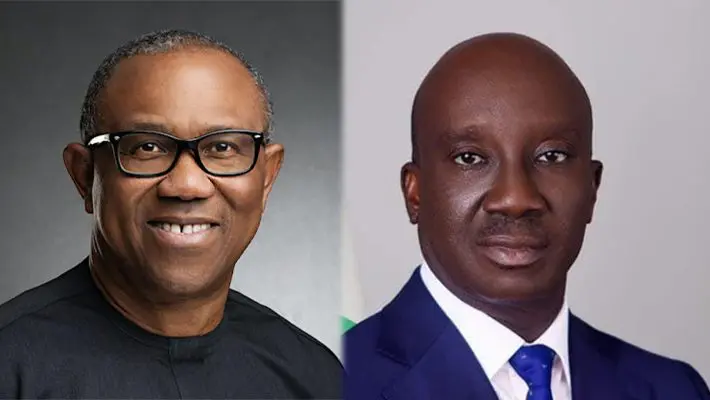
In a democracy, citizenship is not negotiable. It is not subject to political clearance or gubernatorial discretion. Yet, recent events in Nigeria suggest that some state actors have either forgotten this truth—or have chosen to disregard it.
In July 2025, Governor Monday Okpebholo, the All Progressives Congress (APC) Governor of Edo State, issued a public threat against former Anambra State Governor and Labour Party leader Peter Obi. ‘There’s a new sheriff in town,’ he declared, warning that Obi ‘cannot just come into Edo without informing me’ and that ‘his security will not be guaranteed.’ The implications of such a statement are grave.
This follows a similarly troubling episode in April, when Governor Hyacinth Alia of Benue State, also a member of the APC, warned Obi against visiting internally displaced persons (IDP) camps in the state without prior approval. The reason given: the government could not guarantee his safety.
Both incidents reflect a dangerous escalation in Nigeria’s political climate, a creeping normalisation of territorial authoritarianism by subnational leaders. These are not mere instances of campaign rhetoric but disturbing signals of institutional erosion, reminiscent of Nigeria’s troubled political past.
Lessons from History
In the lead-up to Nigeria’s 1964 federal elections, Dr. Michael Okpara, then Premier of the Eastern Region, was denied entry into Kano by Northern authorities while campaigning for the opposition United Progressive Grand Alliance (UPGA). Richard Sklar’s Nigerian Political Parties (1963) and post-independence follow-up essays highlight the severe restrictions placed on UPGA leaders seeking to campaign outside their regional bases.
That political exclusion laid the foundation for the constitutional crisis of 1964–65, a parliamentary boycott, and rising regional tensions. By January 1966, the military had intervened, plunging the country into a cycle of coups, counter-coups, and eventual civil war. Nigeria paid a high price for treating political opposition as a threat rather than a democratic necessity.
The same pattern has played out in other parts of the world. In 1957, Arkansas Governor Orval Faubus infamously deployed the state’s National Guard to block Black students from entering Little Rock Central High School, defying federal desegregation orders. It took President Eisenhower’s intervention, through the deployment of federal troops, to reassert constitutional authority over state-level defiance.
India offers similar cautionary examples. State governments have often misused Section 144 of the Criminal Procedure Code—intended for emergency situations—to prevent political rallies and stifle opposition speech. Indian courts have consistently ruled against such misuse, reaffirming that law and order cannot be a pretext for curbing fundamental freedoms.
A Troubling Double Standard
Even more painfully, this hostility toward Peter Obi, who has carried himself with civility and restraint, raises an uncomfortable question: would such threats be issued if he hailed from another region or bore a different name?
During their years in opposition, both Bola Tinubu and Muhammadu Buhari traversed states freely. No governor dared bar their entry, no matter how politically charged the moment. Why, then, is Obi being treated as a soft target?
This question cannot be ignored. At its heart lies the fear that Nigeria’s democratic space is not equally accessible to all citizens, with some more likely than others to be obstructed, intimidated, or excluded based on their origin or political posture. If true, this represents not just a failure of leadership but a betrayal of the national ideal.
The Nigerian Constitutional Framework
Section 41(1) of Nigeria’s 1999 Constitution is unequivocal: every citizen has the right ‘to move freely throughout Nigeria and to reside in any part thereof.’ No governor, no matter how powerful or popular, has the authority to override this provision. Nor do they exercise control over the Nigeria Police Force or any federal security agency. Security is a federal function, not a state prerogative.
The language used by Governor Okpebholo suggesting that Peter Obi must obtain his ‘permission’ to enter Edo and that his safety cannot be guaranteed goes beyond political theatre. It borders on unlawful intimidation and implies an assumption of powers not granted under any law.
If this rhetoric is allowed to stand, it risks creating a precedent where governors act as gatekeepers of political legitimacy, weaponising security and mobility against opponents. It also raises legitimate fears about the future of state policing in Nigeria. If elected officials, without control of a police force, can already threaten political opponents with impunity, what happens when they are legally empowered to do so?
Recommendations and the Path Forward
Peter Obi’s response to these threats must be principled and assertive. The response is not just for his own sake but also for Nigeria’s democratic integrity.
A dual-track strategy is advised.
Peter Obi should visit Edo State as soon as possible. He should notify the Inspector-General of Police and the Director-General of State Security Services of his intent to visit Edo State and request formal security support, in accordance with the law.
Simultaneously, he should approach the Federal High Court to seek a declaratory judgment affirming his constitutional right to free movement and association, and to challenge the legality of the threats issued against him.
More broadly, the Inspector-General of Police and the National Human Rights Commission should publicly affirm that no Nigerian requires governor’s clearance to move within their country.
The Presidency, as custodian of the Constitution, must reinforce this position to prevent a further descent into regional lawlessness.
Finally, Governor Monday Okpebholo must retract his statement and offer a public apology to Peter Obi and to Nigerians at large. His words were unconstitutional; they betrayed the democratic values he was elected to represent.
Conclusion
Nigeria cannot afford to relive the mistakes of 1964. As we approach the 2027 elections, the political temperature is rising. Now is the time to insist on the rule of law, to protect constitutional freedoms, and to ensure that citizenship remains equal, unthreatened, and non-negotiable.
There must be no part of Nigeria where any citizen — regardless of party, region, or religion — requires permission to be Nigerian.




Barr. O. Chidoka Sir my question is so simple if Peter Obi is to come from other parts of the country will Monday and Nwike had the effontery to dish out this kind of threat to them. Is it because Obi is IGBO. I’m an IGBO man I know what I personally had suffered simply because I am an IGBO. We the IGBOS we’re watching and waiting for when EDO man will come to IMO STATE without getting clearance from us since HATE for the IGBOS has become the cord that binds NIGERIA together. Ka Chukwu mezie Okwu.
Conscience is an open wound and only truth can heal it. Osita Chidoka cut the tree from the root and I concur with him. The presidency’s mute on this issue is dangerous and doesn’t give guarantees a mutual coexistence in any democratic nation. The governors of Benue and Edo states respectively should revise their statements and apologize to Peter obi and Nigerians.
Weldone sir for this beautiful and expository teaching to the D7 governor of Edo state.
Interesting article
You are on point, absolutely!
This fundamental principle of human rights and freedom of movement as guaranteed in Our Constitution is Sacrosanct. The fact that You presented the inherent dangers in such statements from a Public Official elected and bounded by same Constitution is enough proof that the Governor has overstepped his authority. Whatever that we will do to ensure the Governor of Edo State apologies publicly should be pursued. We all know where this audacity is coming from. You were also right about the South East being treated like nobodies. Who is Okpebholo ? Can he issue this same threats to Alhaji Atiku Abubakar?
Thank you so much sir, for this insightful piece. We expect the authorities responsible for doing the right things to rise to the occasion and save the moment.
Aptly said,Barr.👍
Superb Submissions… Ike Obosi,, Daalu SHinne You just stated the facts on the rights of every Citizens.. Thanks a lot
All these minority ethnic groups are hiding under the institutional hate of the Igbo to abuse the Igbo race. They must realise that no condition is permanent. Okpebholo who rushed to Kano to appease the Kano people for the 11 Hausa people killed in his state suggests inferiority complex but holds the Igbo in contempt. What is Edo population to the Igbo. The rule under APC is before you benefit anything from federal government you must be an Igbo hater
Absolutely . Shame on MO. Being led by the noose like a lamb to slaughter. I agree with you totally OC. We mustn’t forget 1964 and the fallouts. The wounds are still raw.
In a country where almost all government branches are compromised . Can they do the right thing? I doubt that, the executive controls everything and it’s difficult to get justice despite how influential you are.
This shows that Nigeria should be divided. There has always been attacks on Igbos by other regions going by history. Lord,may Biafra come
Osyy. Your view is well taken but you should have gone further to say that because he is igbo that why he is treated like this and that we shall demand to separate from Nigeria should any other governor or the federal government in same manner restrict Obi’s movement or any other Igbo man for that matter. Mr Tinubu should as matter of urgency address the nation on this issue as soon as possible. Meanwhile Ohanaeze ndi igbo should task all the Igbo speaking states to start getting ready for our exit. “Igboexit”
I love this….. thanks 🙏👍
They claim Chief security officer of their state unilaterally when they want to achieve a particular interest but goes blank, missing and silent when various crimes are committed under their watch. Let them guarantee the security of people living daily in their state first before seeking for whom to play politics of securing coming from outside. The blueprint has been layed by their president by how he removed a sitting governor unilaterally alleging inexistent threat and lies just to achieve their political aim. I can bet you, it’s just the beginning. More is coming as we approach 2027.
I support the recommendations
Aptly put.